New Technology · Hydrogen Monetizer

Your Surplus Energy
Is a Revenue Stream.
We Unlock It.

E9 Hydrogen's proprietary electrolyzer turns curtailed, negatively-priced renewable energy into green hydrogen — at zero capital cost to the power producer. The Hydrogen Monetizer value chain delivers affordable H₂ and a new revenue stream for every participant.

$0
Capital cost to
renewable host
80%
Lower stack cost vs.
PEM systems
15–18%
Target IRR for
investors
2–3yr
Project payback
period

All figures are internal projections based on CAISO/ERCOT market data as of March 2026. Stack cost reduction vs. iridium/platinum PEM materials. Core electrode & electrolyte performance validated. Independent project-level validation ongoing.

The Hydrogen Monetizer Value Chain
🌞
Renewable Project
Curtailed & negatively-priced surplus energy
E9 Electrolyzer
Turns surplus into green H₂ at ~$0 feedstock cost
🔗
THS Distribution
Aggregates & routes H₂ to offtakers
🏭
Industrial & Transport Offtake
Affordable green H₂ at competitive delivered cost
The Market Problem

Two Industries. One Structural Gap.

Renewable energy projects are wasting billions in generated capacity. Green hydrogen projects are uncompetitive on feedstock cost alone. E9 Hydrogen connects these two broken markets into a single value chain.

Problem 1 — Renewable Energy

Curtailment Is Destroying Project Economics

Solar and wind developers are generating power the grid cannot absorb — and paying the price. Battery storage markets are saturating, ancillary service revenues have collapsed, and PPAs settle on "as-produced" basis, meaning curtailed energy is simply lost revenue.

  • ERCOT curtailed over 8 TWh of wind & solar in 2024 alone
  • BESS arbitrage revenues down 35–71% depending on market (CAISO: 35%, ERCOT: 71%; 2023–2024)
  • ERCOT ECRS & RRS ancillary revenues fell 50–80% as battery saturation spread across ancillary markets (2023–2025)
  • Negative pricing events in CAISO: median –$17/MWh; peaks below –$40/MWh
Problem 2 — Green Hydrogen

Feedstock Costs Make Standalone Projects Unviable

Dedicated green hydrogen projects must purchase grid electricity at market rates. With electricity representing 60–70% of production cost, and grid power priced at $20–$50/MWh for dedicated capacity, green H₂ simply cannot compete with grey hydrogen without heavy subsidy dependence.

  • Dedicated green H₂ electricity cost: $20–$50/MWh (DOE/Lazard 2024)
  • Conventional electrolyzers require 5,000+ hours/year to be economic
  • Federal 45V credit deadline advanced to January 2028 under OBBBA
  • High capex + feedstock costs = unfinanceable without subsidy stacking
E9 Hydrogen
The Hydrogen Monetizer

One Platform. Both Problems. Solved.

E9 Hydrogen deploys turn-key, zero-capital-to-host electrolyzer systems behind the meter at renewable projects — capturing wasted energy and converting it into green hydrogen at near-zero feedstock cost.

Zero-Cost Feedstock
Systems operate during curtailment and negative-pricing windows, achieving median feedstock costs of –$17/MWh — a structural advantage of $37–90/MWh versus dedicated projects.
💰
Zero Capital to the Host Site
E9 owns and operates the equipment. The renewable project contributes only space and surplus power. New revenue begins flowing with no capital outlay required from the host.
🔗
Turnkey Energy-as-a-Service
Delivered as an EaaS partnership with Total Hydrogen Solutions (THS), covering CAPEX, technical integration, NFPA 2 safety compliance, and full commodity offtake and logistics.
🌍
Subsidy-Independent Economics
Financial model excludes 45V production tax credits — viability is built on commodity sales, low feedstock costs, grid services, and resilience revenue. Federal policy shifts don't break the model.
How the Monetizer Works
A 20 MW deployment, illustrative economics
1
Your renewable project generates surplus power — wind, solar, or off-grid capacity that cannot reach the grid or would be curtailed.
2
The E9 electrolyzer activates in seconds — direct DC coupling enables cold starts that capture even short curtailment windows that PEM systems miss.
3
The electrolyzer produces green H₂ — ~850 MT per year from a 20 MW deployment at 29% capacity factor.
4
THS aggregates & routes H₂ — to industrial offtakers, transport networks, or conversion into green ammonia or e-methanol for global commodity markets.
5
Revenue flows to all participants$1.7–$3.4M+ additional annual revenue to the host site at $3–$5/kg net of OPEX. Payback: 3.5–7 years.
E9 Hydrogen
Proprietary Technology

Built for Low Capacity Factors. Nothing Else Can Do This.

Conventional electrolyzers — both PEM and alkaline — require 5,000+ full-load hours per year to be economic (industry benchmark per DOE/NREL techno-economic analyses). E9's proprietary design breaks this constraint. Core electrode and electrolyte performance for H₂ production and separation has been validated — enabling profitable operation at ~2,500 hours per year, half the industry threshold.

Minimum Viable Capacity Factor
~29%
vs. 57%+ for PEM/alkaline
Module Size
10 MW
Modular, scales incrementally
CAPEX vs. PEM Systems
-80%
Material stack cost reduction vs. iridium/platinum PEM
Cold Start Time
Seconds
Direct DC coupling; no warm-up
Validated electrode & electrolyte system — core H₂ production and separation performance has been validated at the component level. Earth-abundant materials (plastic, steel, nickel) replace iridium and platinum, eliminating the critical mineral dependency that makes PEM systems vulnerable to supply chain disruption.
Non-toxic, inexpensive electrolytes — safe to deploy at scale, no exotic chemicals, dramatically lower operational risk.
Proprietary structural design — rings mitigate pressure-induced deformation under high intermittency, enabling reliable operation during the variable renewable windows where the business model captures value.
No power conditioning required — direct DC coupling simplifies integration with renewable projects and eliminates a major BOP cost and failure point.
Low-compression buffer storage — 50–200 bar Type II vessels reduce capex and energy parasitic load vs. high-pressure 700 bar systems. Compatible with industrial offtake and downstream conversion.
Factor
E9 (BTM)
Dedicated GH₂
Power Cost
–$17/MWh median
$20–$50/MWh
Minimum Capacity Factor
~29%
~57%+
Capital to Host Site
$0 (EaaS)
High
Federal Subsidy Reliance
Low
High (45V)
Time to Revenue
Faster (co-located)
Longer (standalone)
Stack Material Risk
Low (abundant)
High (Ir, Pt)
Target Project IRR
15–18%
Subsidy-dependent
The Synthetic Blue Bridge

To address seasonality in solar-dependent production, E9 employs a blending strategy: ~30% E9-produced green hydrogen blended with ~70% conventional grey hydrogen, achieving blue hydrogen equivalent specifications with carbon accounting. This enables continuous offtake supply while green production scales — capturing near-term market demand without waiting for full green supply ramp.

The blended stream is carbon-accounted on a mass-balance basis. In California, the pathway is eligible for LCFS credit registration under CARB's 2025 amendments, adding ~$1/kg incremental revenue on the green fraction. The blend does not qualify for Section 45V production tax credits, which require dedicated clean hydrogen — consistent with E9's subsidy-independent financial model. As E9 fleet capacity grows, the green fraction scales toward 100%, progressively improving both carbon intensity and offtake pricing.

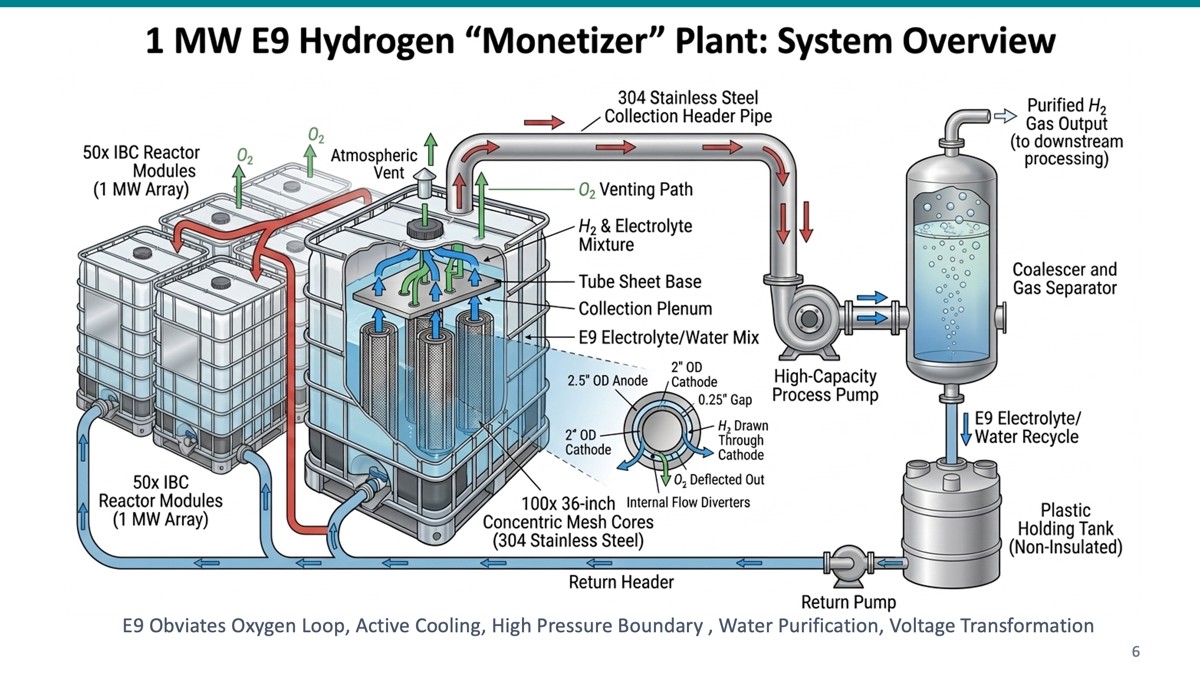
System Diagram

How the E9 Electrolyzer Works

The 1 MW E9 "Monetizer" plant uses 50x IBC Reactor Modules per array — simple, rugged stainless steel concentric mesh cores — eliminating the oxygen loop, active cooling, high-pressure boundary, water purification, and voltage transformation required by conventional PEM systems.

1 MW E9 Hydrogen Monetizer Plant: System Overview
The Monetizer Value Chain

From Wasted Watts to Global Markets

Every participant in the chain gains. Renewable projects capture new revenue. H₂ developers access the lowest-cost feedstock in the market. Offtakers receive affordable, traceable green hydrogen. Investors earn returns that don't depend on federal subsidies.

🌬️
Step 01
Surplus Capture
Renewable project with curtailed or negatively-priced generation activates the E9 behind the meter
⚗️
Step 02
H₂ Production
E9 electrolyzer converts surplus power to green hydrogen at near-zero feedstock cost, operating down to 29% CF
🔗
Step 03
Aggregation & Conversion
THS aggregates H₂ output; conversion to ammonia or e-methanol enables global commodity export
💎
Step 04
Revenue for All
$1.7–$3.4M+ p.a. to host; affordable H₂ for offtakers; 15–18% IRR for investors; global green commodity export
🌿
Green Hydrogen (H₂)
Direct gaseous H₂ to industrial offtakers — Gulf Coast refineries, chemical plants, fuel cell vehicle networks. $4.00–$6.00/kg at 10 MW scale.
2–3 yr payback (CA: 2yr, TX: 3yr)
⚗️
Green Ammonia (NH₃)
Haber-Bosch conversion for fertilizer and zero-carbon maritime fuel. Gulf Coast export via Port of Corpus Christi. Market: $700–$900/MT green premium.
~4 yr payback · Maritime fuel momentum
🛢️
e-Methanol
H₂ + biogenic CO₂ → e-methanol for marine fuel markets. Maersk, CMA CGM, MSC already contracting for delivery. Liquid at room temperature — easiest to transport.
~2.8 yr payback · Active supply contracts
Who We Serve

Built for the Entire Value Chain

The Hydrogen Monetizer creates value at every node. Whether you own the generation, need the hydrogen, provide the capital, or set the policy — there is a role for you.

📈
Primary Audience
Investors
Target 15–18% IRR on energy infrastructure with subsidy-independent economics. Complexity-stacking model combines commodity sales, low feedstock cost, grid services, and resilience revenue. 2–3 year payback on base case. No 45V dependency.
Discuss Investment
🏗️
Primary Audience
H₂ Project Developers
Access the lowest-cost green H₂ feedstock in the market — median –$17/MWh vs. $20–$50/MWh for dedicated projects. Eliminate feedstock risk. Deploy faster via co-located behind-the-meter model. Differentiate with subsidy-independent unit economics.
Explore Development
🌞
Primary Audience
Renewable Project Owners
You're generating power the grid can't absorb. We turn that curtailed and negatively-priced energy into $1.7–$3.4M+ in additional annual revenue — with zero capital outlay. E9 owns the equipment. You provide the space and the surplus.
Start Earning
🏭
Primary Audience
Green H₂ Offtakers
Industrial facilities, transport operators, and maritime fuel buyers: access affordable, traceable green hydrogen through the THS offtake network. The Hydrogen Monetizer's structural cost advantage passes through to offtake pricing — making green H₂ viable today.
Secure Offtake
📋
Secondary Audience
Policy Makers & Analysts
The Hydrogen Monetizer demonstrates a commercially viable, subsidy-light pathway to green hydrogen commercialization — built on market structure, not tax credits. Relevant to hydrogen strategy, RPS design, curtailment policy, and IRA/OBBBA impact assessment.
Request Briefing
🤝
Key Partner
Total Hydrogen Solutions (THS)
THS is E9's key commercialization partner — designing, producing, installing, and supporting the full system; financing equipment; aggregating and managing H₂ offtake to industrial and transportation customers. Together, E9 + THS deliver the complete value chain.
Partnership Details
Deployment Paths

Two Markets. Same Breakthrough.

The E9's ability to operate profitably at low capacity factors opens two large and growing markets — each driven by the same underlying dynamic: renewable energy with nowhere to go.

Path A

Off-Grid & Islanded Infrastructure

Grid-independent AI campuses and data centers deliberately overbuild renewable generation by 2–3x to guarantee 24/7 availability. This creates massive seasonal surplus — a "Solar Tsunami" in summer — that lithium-ion cannot absorb economically beyond 4-hour windows.

  • E9 converts stranded summer surplus into on-site H₂ for backup power
  • Replaces diesel with zero-emission resilience — critical as Clean Air Act permitting tightens
  • Exports surplus as green ammonia or e-methanol via Gulf Coast corridors
  • Data center downtime avoided: $100K–$500K/hour value at risk
  • Target markets: West Texas AI campuses, California off-grid microgrids
Path B

Behind-the-Meter for Grid-Connected Renewables

Grid-connected renewable developers face curtailment and negative pricing that PPAs don't cover. The E9 sits behind the meter, absorbing energy during curtailment windows and converting it to hydrogen — monetizing 100% of generated capacity regardless of grid constraints.

  • ERCOT: 8 TWh curtailed in 2024 — lost PPA revenue convertible to H₂ revenue
  • E9 operates profitably on curtailment peaks alone — no baseload needed
  • Renewable developer contributes zero capital; receives revenue share
  • H₂ routed to THS offtake network for industrial and transport markets
  • Target markets: ERCOT Texas, CAISO California, WECC curtailment zones
Watch & Learn

The Case in Motion

These short videos explain the Hydrogen Monetizer thesis — the market problem, the technology advantage, and the commercial opportunity.

Overview
The Hydrogen Monetizer
The core thesis: how E9 turns curtailed renewable energy into a power-to-revenue platform for every participant in the value chain.
Deep Dive
The Hydrogen Monetizer — Part 2
A deeper look at the commercial model, partnership structure, and how the value chain delivers for investors, developers, and offtakers.
Market Context
The Green Fuel Paradox
Why green hydrogen has struggled to scale — and how the Hydrogen Monetizer's behind-the-meter model resolves the economics that have held the industry back.
The Opportunity
The Green Hydrogen Renaissance
The market forces — curtailment growth, BESS saturation, maritime fuel mandates — that make 2026–2030 the defining window for green hydrogen commercialization.
E9 Hydrogen
Key Commercialization Partner

E9 + THS: The Complete Value Chain

E9 Hydrogen provides the breakthrough electrolyzer technology. Total Hydrogen Solutions (THS) delivers the commercialization engine. Together, the partnership covers every link in the chain from surplus power to offtake revenue.

E9 Hydrogen — Technology
Provides the proprietary low-cost electrolyzer system, designed specifically to operate profitably at low capacity factors. Delivers the structural cost advantage that makes behind-the-meter economics work.
Total Hydrogen Solutions — Commercialization
Designs, produces, installs, and supports the full integrated system. Provides or arranges project finance. Aggregates and manages hydrogen offtake to industrial and transportation customers. Handles NFPA 2 compliance and commodity logistics.
Third-Party Developers — Finance
Project financing provided by third-party developers in the THS network. The power producer contributes zero capital — only access to surplus power and site real estate.
Two-Sided Market Model
The E9 + THS partnership creates a two-sided market: on the supply side, E9 provides the lowest-cost electrolysis technology; on the demand side, THS aggregates industrial and transport offtake. Both sides of the market benefit from the structural feedstock cost advantage — making green hydrogen commercially viable today.
E9 Hydrogen
+
The Hydrogen Monetizer
Implementation Roadmap
1
Phase 1 — Demonstration (Early 2027)
1 MW E9 deployment at 100–500 MW renewable site in West Texas or California. Validate 24-hour intermittent operation and negative-pricing capture.
2
Phase 2 — Scale-Up (2028)
Expand to GW-scale islanded campuses. Scale E9 fleet to 50 MW+ integrated with 200 MW solar overbuild. Establish Gulf Coast commodity export for green ammonia and e-methanol.
E9 Hydrogen
Financial Framework

Returns That Don't Depend on Washington.

The financial model deliberately excludes Section 45V production tax credits. Viability is built on four durable revenue drivers that persist regardless of federal policy.

15–18%
Target IRR
Complexity stacking model — no 45V dependency. Well above traditional standalone storage returns.
2–3yr
Project Payback
2.0 yr (California, LCFS-enhanced) to 3.0 yr (Texas) gross payback at 10 MW scale. After ITC and 100% bonus depreciation: 1.5–2.3 yr.
$0
Capital to Host Site
E9 owns and operates all equipment. Renewable project contributes only space and surplus power. Revenue share from day one.
Revenue Stacking — The Four Drivers
Revenue Driver Mechanism Market Notes
Commodity Sales Green H₂, ammonia, e-methanol sold into industrial and maritime markets TX & CA Primary revenue driver; H₂ at $4–$6/kg; NH₃ at $700–$900/MT
Low Feedstock Cost Electrolyzers operate during negative pricing / curtailment windows TX & CA Median –$17/MWh CAISO 2024; structural $37–90/MWh advantage vs. dedicated
Grid Services Integrated fuel cells & batteries participate in ancillary service markets ERCOT ECRS, Non-Spin; incremental revenue stack on top of H₂ production
LCFS Credits California Low Carbon Fuel Standard pathway registration CA only ~$1/kg incremental H₂ revenue; CARB confirmed 2025 amendments
Resilience Premium H₂ backup power for data centers; replaces diesel Both $100K–$500K/hr downtime value; avoided diesel permitting costs
Negative LMP Credits Payments/credits received when offtake power carries negative LMP Both Structural advantage built into base case — not an upside scenario

All figures are internal projections based on CAISO/ERCOT market data as of March 2026. Independent validation ongoing. 45V production tax credits excluded from base case. Section 48E ITC and OBBBA 100% bonus depreciation applied where eligible. Payback periods should be stress-tested against actual installed cost quotes before investor presentations.

E9 Hydrogen
Leadership Team

Built to Execute.
Not Just Theorize.

E9's team spans fundamental physics, electrical and mechanical engineering, electrochemistry, energy markets, project finance, and commercial development — the full stack required to bring breakthrough electrolysis technology to market.

Darrel Smith, P.E.
Darrel Smith, P.E.
Chairman & Chief Technology Officer
📍 Sandy, OR
Fluid Systems · Electrolysis · Mechanical Engineering
Founder of E9 Hydrogen. Has investigated green hydrogen production systems for over a decade. Leads fundamental physics through manufacturing — specializing in fluid system design, breakthrough gas separation IP, and a more efficient, less expensive Balance of Plant.
Mark Allen, P.E.
Mark Allen, P.E.
Chief Executive Officer
📍 Denver, CO
Systems Design · Manufacturing Scale-Up · Supply Chain
Drives commercial strategy and company operations. Electrical engineer with a track record executing new technology products through rapid manufacturing scale-up and supply chain management.
Cassio Conceicao
Cassio Conceicao
Chief Financial Officer
📍 Silicon Valley, CA
Project Finance · Renewable Energy · FEED Studies
Leads financial strategy and investor relations. Electrical engineer background with deep experience in renewable energy financing, Pre-FEED and FEED studies, and guiding energy projects to Final Investment Decision.
Bill Croyle
Bill Croyle
Chief Marketing Officer
📍 Denver, CO
Commercialization · Market Development · H₂ Consumer Markets
Leads commercialization strategy and market development. Brings hydrogen consumer expertise across agriculture, industrial products, hydrogenation, fuels, and transportation — connecting E9's technology to the markets that need it.
Blake Putney
Blake Putney
EVP Strategic Systems Integration
📍 Silicon Valley, CA
Systems Integration · Electrical Engineering · Permitting
Drives systems integration and client partnerships. Electrical engineer specializing in advanced systems design to simplify and eliminate components for reliability, maintainability, and manufacturability — and integrating hydrogen projects for efficient permitting.
Joel Butler
Joel Butler
VP Manufacturing Ecosystem
📍 Boulder, CO
Electrical Generation · Off-Grid · Renewables Integration
Leads manufacturing partnerships and ecosystem development. Expertise in electrical generation, transmission and distribution, with a focus on intermittent renewables and off-grid operations — critical to the Hydrogen Monetizer deployment model.
Narendra Pal, PhD
Narendra Pal, PhD
Systems Integration
📍 Silicon Valley, CA
Hydrogen · Maritime · Materials Science · Safety Standards
30 years of professional experience in renewable energy, hydrogen, liquid hydrogen, maritime hydrogen, automotive, materials handling, ports' decarbonization, and safety codes and standards. Mechanical engineer specializing in energy and materials science.
Advisory Board
Advisor
Steve Bares
Business Processes · Chemical Engineering
Experienced innovation executive with a Ph.D. in Physical Chemistry and an MBA. Previously President and Executive Director of Memphis Bioworks Foundation and Associate Vice Chancellor for Research & Entrepreneurship at UTHSC. Guides IP strategy and company chemistry and technical team building.
Advisor
Jan Pepper
Green Energy Ecosystem
Senior clean-energy leader with over 30 years of experience in renewable energy, utilities, and community-choice energy programs. Founding CEO of Peninsula Clean Energy, where she led renewable procurement, market design, and strategic partnerships. Guides energy-market engagement strategy.
Team Institutional Background
Competitive Positioning

Uniquely Positioned.
No One Else Is Here.

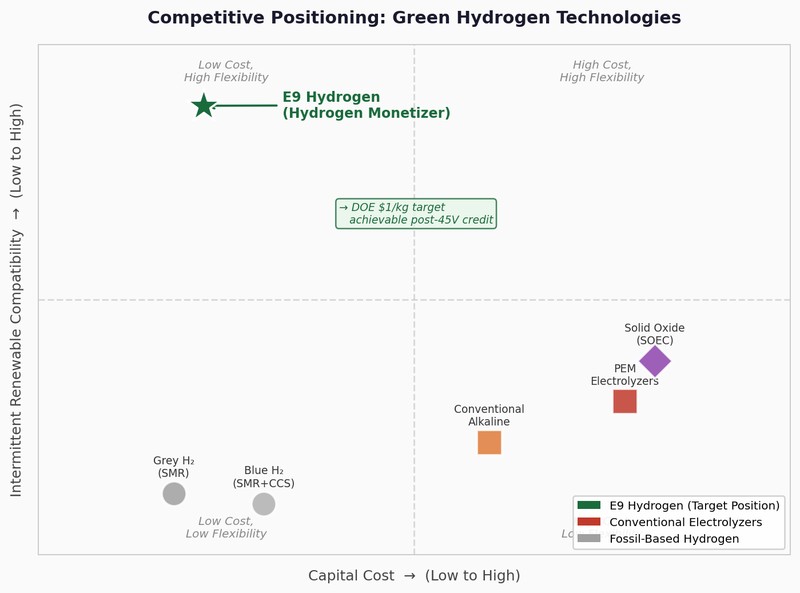
E9 Hydrogen (Hydrogen Monetizer) occupies the only position in the green hydrogen landscape that combines low capital cost with high renewable compatibility — enabling deployment where no other electrolyzer can operate profitably.

Competitive Positioning: Green Hydrogen Technologies
E9 Target Position
High renewable compatibility + Low capital cost. No other electrolyzer technology occupies this quadrant — it requires the E9's unique ability to operate profitably at ~29% capacity factor using earth-abundant materials.
PEM Electrolyzers
High capital cost, high flexibility — require iridium and platinum, 5,000+ hr/year to be economic (DOE/NREL benchmark). Priced out of intermittent renewable deployment.
Conventional Alkaline
Low cost, low flexibility — designed for steady baseload industrial hydrogen. Cannot tolerate the intermittent inputs that define the curtailment opportunity.
Get Involved

Join the Hydrogen Monetizer Value Chain

Whether you own generation, need hydrogen, provide capital, or shape policy — there is a role in the value chain for you. Reach out to explore how you can participate.

📈
For Investors
Review our financial model and investor brief. 15–18% target IRR on subsidy-independent energy infrastructure.
🌞
For Renewable Project Owners
Learn how much additional revenue your curtailed generation could produce. No capital required from you.
🏗️
For H₂ Developers & Offtakers
Discuss H₂ supply agreements and project development partnerships with the E9 + THS team.
📋
For Policy Analysts
Request a briefing on the Hydrogen Monetizer model, market data, and its implications for green hydrogen policy.
Start the Conversation
Tell us who you are and how we can help. We'll follow up within 2 business days.